

For People Who Smoke
Addiction to nicotine is not your fault, and you are not alone if you struggle to quit.
Tobacco use disorder – or being addicted to the nicotine in cigarettes and other tobacco products – affects more than


worldwide.
Cigarette smoking remains the leading cause of preventable death across the globe, and most people who smoke live in low- and middle-income countries. We’re here to help you understand why it is so hard to quit, and to get the facts about options that can help you quit and minimize your risk.
Nicotine is an addictive chemical found in tobacco leaves. It also can be produced synthetically. It is not what makes tobacco harmful to health. But it is dependency-forming, or addictive, and many people who use cigarettes regularly experience great difficulty quitting. It is the repeated exposure to the thousands of other chemicals, 69 carcinogens (cancer-causing chemicals) produced when a cigarette is burned that kills fully half of all long-term cigarette smokers.
Quitting smoking is a personal journey. Research shows that many people who smoke try to quit a number of times before they are successful. In addition to the physical addiction to nicotine, many people feel that smoking helps them cope with stress and anxiety. But research shows that quitting can actually lower long-term stress levels.
It’s okay if you’re not able to quit the first time you try, or even in your first few tries – but keep trying. Think of every quit attempt as a chance to learn what works for you and what does not. Any day is a great day to try again.

There are medications that can help you quit smoking. These include some that your doctor can prescribe and some over-the-counter products called nicotine replacement therapies (NRT), including nicotine patches (also known as plasters) and gum. These medications either provide the body with some nicotine to ward off intense cravings or decrease the pleasurable feelings from nicotine.
Currently available medical products do not work for everyone. If you cannot or are otherwise unwilling to quit smoking using traditional medications, there are other options for you to consider. These products contain nicotine but are not burned and therefore expose your body to far fewer chemicals than cigarettes and other combustible tobacco products. These options include nicotine, sprays, and inhalers, vaping products (e-cigarettes), nicotine pouches, heated tobacco products, and snus. (Snus is an oral smokeless tobacco product the use of which, due to its unique manufacturing process, is not a significant risk factor for developing lung cancer, cardiovascular disease, pancreatic cancer, or oral cancer).
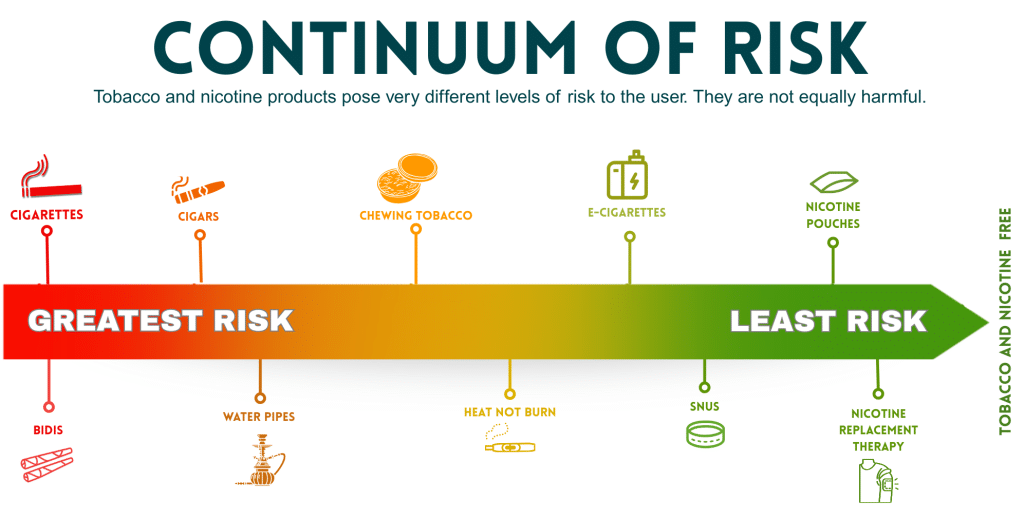
Combustible tobacco products and reduced-risk products exist on what researchers call the continuum of risk. In 2017, top medical product and tobacco regulators at the U.S. Food and Drug Administration (FDA) identified the continuum of risk as part of a comprehensive plan to regulate nicotine products. The continuum of risk highlights that combustible, or burned, tobacco products like cigarettes and cigars put a person at the highest risk of severe illness, while nicotine replacement therapies like the gum and the patch put users at the lowest risk along the continuum.
There is no safe non-medicinal product that contains nicotine, but if individuals who smoke are unable or otherwise unwilling to quit, then switching to nicotine-containing products at the lower end of the continuum can reduce their risk of suffering serious illness.
The contents of this website and related Global Action communications and materials are presented for information purposes only and are not intended as medical advice, nor to replace the advice of a medical doctor or healthcare professional.
Stay Updated
Sign up to receive news, updates, and learn how you can take action.
Whatever your goals are, there are tools available to support you:
Pharmaceutical products (medications) Rx required
Bupropion – an antidepressant that can help mitigate the side effects of quitting nicotine
Varenicline – a drug that blocks the effects of nicotine
Cytisinicline – a drug that blocks the pharmacologic effects of nicotine, available in some parts of the world without a prescription
Nicotine replacement therapies (NRTs)
Various forms of nicotine that have been approved by the U.S. Food and Drug Administration and health regulatory agencies in other countries to help people who smoke to quit. These products are often available without a prescription, but a prescription from a health care provider can lower out-of-pocket costs. It is possible to use more than one of these products at the same time, including while using a prescription medication, to increase your chances of success. This is known as “combination therapy,” and professional guidance is recommended.
These regulated medicinal NRTs include:
- Nicotine lozenges
- Nicotine patches
- Nicotine gum
- Nicotine inhalers
- Nicotine sprays
Reduced-risk products (RRPs)
Reduced-risk nicotine products have not been cleared formally by medical authorities to help people who smoke quit, but they produce far fewer chemicals than cigarettes or other combustible tobacco products, and some have been authorized by the U.S. Food and Drug Administration. Scientific reviews have found that some of these options, like vaping products (e-cigarettes), are more effective for many people who smoke and are trying to quit than are NRTs.
RRPs include:
- Electronic cigarettes (e-cigarettes, e-cigs, vapes): contain nicotine and often flavors that are mixed into a colorless, odorless liquid (for example, propylene glycol) that is heated to produce an aerosol (vapor).
- Heated tobacco products: contain tobacco sticks that are heated at a high temperature, but not so hot they combust, to release nicotine.
- Nicotine pouches: placed in the mouth and slowly release nicotine.
Whether your goal is to quit smoking or to stop using nicotine entirely, there are a number of options that can help.
Depending on where you are, the products available to you may vary. Talk to a trusted health care provider about which may be right for you. The following external resources may also help you on your journey:
- Smokefree.gov
A U.S.-based website of credible information that can offer tips to quit smoking. - The Africa Harm Reduction Alliance
A non-profit resource for those living in Africa - Quit Strong
A federal resource from New Zealand - Smoking, Vaping and Tobacco
A federal resource from Canada - Quit Smoking
A federal resource from the United Kingdom - The Global State of Tobacco Harm Reduction
A project from Knowledge Action Change (KAC) that contains up-to-date information on smoking statistics and harm reduction options available across the globe. (KAC receives funding from Global Action to end Smoking.)
We want to hear from you.
Get the Facts
The first step to ending the tobacco epidemic and its harm to global health is to understand it.
Smoking kills half of all regular, long-term users. It is the leading preventable cause of death worldwide, but it does not have to be. With the right information, resources, and support, all people who smoke can decrease their tobacco-related risks and improve their health.
We are committed to disseminating the most rigorous and up-to-date information about the health impact and relative risks of tobacco and nicotine products with accuracy. We will update this page regularly as new scientific evidence emerges.
Combustible tobacco use is the leading preventable cause of death
Why is smoking so dangerous?
There are many harmful chemicals in tobacco and especially in tobacco smoke. Smoking tobacco is the most dangerous way to consume nicotine.
Click to Read MoreWhat is tobacco harm reduction?
Tobacco harm reduction is the idea that people can reduce their risks of smoking by consuming nicotine in alternative ways, including heated tobacco products, e-cigarettes, nicotine pouches, or snus.
Click to Read MoreWhat is Global Action to End Smoking? How are you different from other public health groups?
We are a foundation that is committed to ending the disease and death caused by the global smoking epidemic. The research we support identifies real-world solutions to help individuals quit smoking.
Click to Read MoreIs smoking still a problem?
Smoking remains the leading preventable cause of death worldwide.
Click to Read MoreAre nicotine pouches dangerous?
Global health authorities have concluded that nicotine pouches, which do not contain tobacco, are significantly less risky than cigarettes. However, this does not mean that they are safe or risk-free.
Click to Read MoreHow risky are e-cigarettes (vapes) compared to cigarettes?
Global health authorities have concluded that e-cigarettes are significantly less risky than cigarettes. However, that does not mean these products are safe or risk-free.
Click to Read MoreIs nicotine dangerous?
Nicotine is highly addictive and is not benign. But it is the many other chemicals in tobacco, and especially in tobacco smoke, that make cigarettes and some other tobacco products so harmful.
Click to Read MoreHow does Global Action fund grants?
Global Action’s research program is guided by experienced researchers and public health professionals and follows a rigorous review process to ensure we’re supporting the highest quality research possible.
Click to Read MoreWhat's the best way to read new nicotine and tobacco research myself?
There is a lot of new information being published daily, and sometimes papers may reach conflicting conclusions. In short, read news stories and scientific papers carefully. We have more tips here.
Click to Read MoreWhat is the continuum of risk?
Some ways of consuming nicotine are significantly less risky than others.
Click to Read MoreWhat is a reduced-risk product?
Reduced-risk nicotine products include heated tobacco products, e-cigarettes, nicotine pouches, and more. Using these products instead of combustible cigarettes is engaging in a form of tobacco harm reduction to move down the nicotine continuum of risk if a person cannot or will not quit smoking otherwise.
Click to Read MoreWhy do so many people struggle to quit smoking?
Although nicotine addiction is the primary reason why many people who smoke continue to do so, even when they want to stop, but there are other reasons as well. For example, many people feel smoking helps them manage their emotions and stress – which can make it harder to quit.
Click to Read MoreDidn’t e-cigarettes cause EVALI and things like popcorn lung?
In a word, no. But EVALI highlights the need for a carefully regulated nicotine market.
Click to Read MoreWhat are scientists still studying about nicotine, tobacco, and reduced-risk nicotine products?
Current evidence supports the use of reduced-risk products to greatly lower exposure to harmful chemicals compared to continuing to smoke. However, there may be longer-term health effects of using these products that are not yet known.
Click to Read MoreWhere can I learn more about nicotine and how to quit?
There are many global resources to help you quit smoking.
Click to Read More