
This page was last edited on May 30, 2025

Get the Facts

The first step to ending the tobacco epidemic and its harm to global health is to understand it.

Smoking kills half of all regular, long-term users. It is the leading preventable cause of death worldwide, but it does not have to be. With the right information, resources, and support, all people who smoke can decrease their tobacco-related risks and improve their health.

We are committed to disseminating the most rigorous and up-to-date information about the health impact and relative risks of tobacco and nicotine products with accuracy. We will update this page regularly as new scientific evidence emerges.

Combustible tobacco use is the leading preventable cause of death
Cigarette Smoking
6.2 MILLION
Alcohol
1.8 MILLION
Illicit drugs (463.4K)
Auto accidents (396.5K)

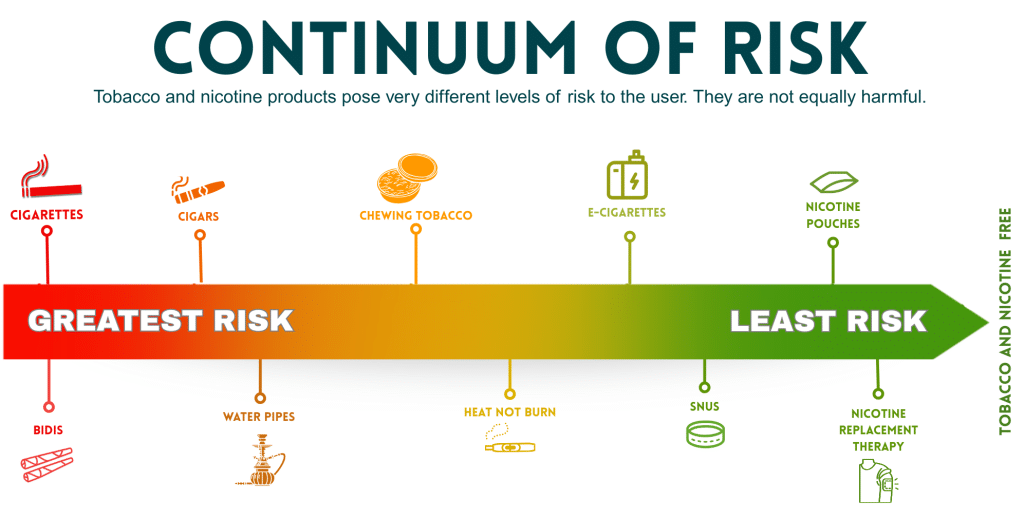
A graphic depicting the nicotine continuum of risk.

Why is smoking so dangerous?

There are many harmful chemicals in tobacco and especially in tobacco smoke. Smoking tobacco is the most dangerous way to consume nicotine.

Click to Read More

What is tobacco harm reduction?

Tobacco harm reduction is the idea that people can reduce their risks of smoking by consuming nicotine in alternative ways, including heated tobacco products, e-cigarettes, nicotine pouches, or snus.

Click to Read More

What is Global Action to End Smoking? How are you different from other public health groups?

We are a foundation that is committed to ending the disease and death caused by the global smoking epidemic. The research we support identifies real-world solutions to help individuals quit smoking.

Click to Read More

Is smoking still a problem?

Smoking remains the leading preventable cause of death worldwide.

Click to Read More

Are nicotine pouches dangerous?

Global health authorities have concluded that nicotine pouches, which do not contain tobacco, are significantly less risky than cigarettes. However, this does not mean that they are safe or risk-free.

Click to Read More

How risky are e-cigarettes (vapes) compared to cigarettes?

Global health authorities have concluded that e-cigarettes are significantly less risky than cigarettes. However, that does not mean these products are safe or risk-free.

Click to Read More

Is nicotine dangerous?

Nicotine is highly addictive and is not benign. But it is the many other chemicals in tobacco, and especially in tobacco smoke, that make cigarettes and some other tobacco products so harmful.

Click to Read More

How does Global Action fund grants?

Global Action’s research program is guided by experienced researchers and public health professionals and follows a rigorous review process to ensure we’re supporting the highest quality research possible.

Click to Read More

What's the best way to read new nicotine and tobacco research myself?

There is a lot of new information being published daily, and sometimes papers may reach conflicting conclusions. In short, read news stories and scientific papers carefully. We have more tips here.

Click to Read More

What is the continuum of risk?

Some ways of consuming nicotine are significantly less risky than others.

Click to Read More

What is a reduced-risk product?

Reduced-risk nicotine products include heated tobacco products, e-cigarettes, nicotine pouches, and more. Using these products instead of combustible cigarettes is engaging in a form of tobacco harm reduction to move down the nicotine continuum of risk if a person cannot or will not quit smoking otherwise.

Click to Read More

Why do so many people struggle to quit smoking?

Although nicotine addiction is the primary reason why many people who smoke continue to do so, even when they want to stop, but there are other reasons as well. For example, many people feel smoking helps them manage their emotions and stress – which can make it harder to quit.

Click to Read More

Didn’t e-cigarettes cause EVALI and things like popcorn lung?

In a word, no. But EVALI highlights the need for a carefully regulated nicotine market.

Click to Read More

What are scientists still studying about nicotine, tobacco, and reduced-risk nicotine products?

Current evidence supports the use of reduced-risk products to greatly lower exposure to harmful chemicals compared to continuing to smoke. However, there may be longer-term health effects of using these products that are not yet known.

Click to Read More

Where can I learn more about nicotine and how to quit?

There are many global resources to help you quit smoking.

Click to Read More

This website does not provide medical advice.

The information, including but not limited to, text, graphics, images and other material contained on this website are for informational and educational purposes only and does not constitute providing medical advice or professional services. No material on this site is intended to be a substitute for diagnosing or treating a health problem or disease. Those seeking personal medical advice should consult with a licensed physician or other qualified health care provider. Always seek the advice of your licensed physician or other qualified health care provider regarding a medical condition or with any questions you may have regarding treatment and before undertaking a new health care regimen. Never disregard professional medical advice or delay in seeking it because of something you read on this website. If you think you may have a medical emergency, call 911 or go to the nearest emergency room immediately. No physician-patient relationship is created by this website or its use. Neither Global Action nor its employees, nor any contributor to this website, makes any representations, express or implied, with respect to the information provided on this website or in connection with its use.

Why is smoking so dangerous?

There are many harmful chemicals in tobacco, especially in tobacco smoke. Smoking tobacco is the most dangerous way to consume nicotine.

Tobacco is a plant whose leaves are used to create combustible or smokeless products. Its leaves contain many chemicals that can be harmful to human health, including some that lead to many forms of cancer. It also contains nicotine, which is an addictive chemical.

Though nicotine is not what causes the deadly illnesses resulting from inhalation of tobacco smoke, it is the primary chemical that makes them addictive. The repeated exposure to other chemicals in tobacco due to nicotine addiction is what leads to the death and disease associated with smoking.

Burning tobacco is by far the most dangerous way to consume nicotine. Tobacco smoke contains more than 7,000 chemicals, including 250 which are known to be detrimental to human health, and 69 of which cause cancer.

There is a continuum of risk when it comes to consuming nicotine. Using nicotine in ways that are less dangerous than combustible cigarettes is often referred to as engaging in tobacco harm reduction.

For example, some forms of smokeless tobacco, like chewing tobacco, contain roughly 28 chemicals known to cause cancer. Other forms of nicotine, including heated tobacco products, e-cigarettes, nicotine pouches and snus, appear to have minimal risks and exposure to harmful substances. Global heath authorities have acknowledged that if an adult who smokes switches entirely to some of these other products, they are significantly reducing their health risks even if they don’t quit using nicotine entirely.

The tobacco plant is also used in rituals and ceremonies in many indigenous cultures, but these uses are not known to contribute to the global burden of death and disease because they involve very limited exposure to tobacco smoke.

What is tobacco harm reduction?

Tobacco harm reduction is the idea that people can reduce their risks of smoking by consuming nicotine in alternative ways, including heated tobacco products, e-cigarettes, nicotine pouches, or snus.

While none of these products are approved as smoking cessation products, using them instead of cigarettes significantly reduces a person’s risk of disease and death related to smoking.

In general, harm reduction is an idea in public health that if people engage in behavior with known risks, health authorities should find ways to help them mitigate those risks rather than try to stop the behavior. Traditional harm reduction includes educating individuals on safe sex practices or providing opportunities for people who use drugs to access clean needles, but even wearing a seatbelt while riding in a car is a form of harm reduction.

It is impossible to overlook the fact that industry wrongdoing led to the smoking epidemic that persists today. But the fact remains that tobacco harm reduction is a valid form of improving public health if it means fewer people will smoke cigarettes.

What is Global Action to End Smoking? How are you different from other public health groups?

Global Action is a charitable grantmaking organization that accelerates research to save lives. We are searching for global solutions to end death and disease caused by smoking. We are a leading global public health entity that accepts tobacco harm reduction as a valid way to improve public health by helping individuals move down the continuum of risk.

We respect and have compassion for people who smoke and understand that some cannot or will not quit. We correct misperceptions regarding nicotine and ensure health care providers and people who smoke understand the benefits of quitting smoking, even with the continued use of reduced-risk nicotine products.

Our grantmaking focuses on three main subject areas: Health and Science Research, Cessation Education, and Agricultural Transformation. We collaborate with academic and research centers and other experts to accelerate life-saving research and educational projects. We particularly value work that impacts low- and middle-income countries or marginalized communities, as those groups smoke at higher rates than the general population.

Global Action to End Smoking is an independent, U.S. nonprofit 501(c)(3) grantmaking organization. Through September 2023, Global Action received charitable gifts from PMI Global Services Inc., a subsidiary of Philip Morris International Inc. (PMI). In 2023, the organization terminated its agreement with PMI, and our Board of Directors then adopted a formal new policy not to accept funding from companies that produce tobacco or non-medicinal nicotine products.

Is smoking still a problem?

Smoking remains the leading preventable cause of death worldwide.

Smoking – by far the most popular form of tobacco use – kills 6.2 million people every year by some estimates. Chronic exposure to secondhand tobacco smoke leads to more than a million additional deaths annually.

Over 1 billion people smoke, the majority of whom live in low- and middle-income countries. More men smoke than women. Risk factors for smoking vary by country. The number of people who smoke has declined to just over 20 percent globally, but the rate of decline has slowed over the past decade, and some countries and cultures have much higher rates of smoking.

Are nicotine pouches dangerous?

Global health authorities have concluded that nicotine pouches, which do not contain tobacco, are significantly less risky than cigarettes. However, this does not mean that they are completely safe or risk-free

Nicotine pouches contain nicotine, the addictive stimulant in tobacco, and some flavorings, but not the dangerous chemicals found in combustible tobacco products. Global health authorities in some parts of the world have concluded that nicotine pouches are appropriate for the protection of public health, according to the U.S. Food and Drug Administration, which means that the potential benefits for adults who smoke in switching outweigh the potential risks to youth or those who have never smoked. They are a form of tobacco harm reduction.

Similar to e-cigarettes, nicotine pouches are not risk-free. Nicotine should not be used by anyone who has never used it before – especially youth. However, nicotine pouches are likely to be even less risky than e-cigarettes because they do not involve inhaling nicotine.  

How risky are e-cigarettes (vapes) compared to cigarettes?

Global health authorities have concluded that e-cigarettes are significantly less risky than cigarettes. However, that does not mean these products are completely safe or risk-free. 

E-cigarettes contain nicotine, the addictive stimulant in tobacco. They contain nicotine, the addictive stimulant in tobacco, and some flavorings, but not the most dangerous chemicals found in combustible tobacco products. Global health authorities in some parts of the world have concluded that nicotine pouches are appropriate for the protection of public health, which means that the potential benefits for adults who smoke in switching outweigh the potential risks to youth or those who have never smoked. They are a form of tobacco harm reduction.

It’s important to note that even if e-cigarettes are less harmful, it doesn’t mean that they’re completely safe. Nicotine should not be used by anyone who has never used it before – especially youth. Additionally, e-cigarettes contain other chemical components, including flavoring agents, some of which have unknown health effects.

Scientists know less about the long-term risks of e-cigarettes because they are relatively new compared to cigarettes, but also because the market is largely unregulated. Even though global health authorities have tried to regulate this large market, new types of e-cigarettes are being marketed every day. These unregulated e-cigarettes may contain chemicals public health authorities are unaware of, and therefore are unable to verify their safety. 

In sum, e-cigarettes are relatively less harmful than cigarettes and can offer adults who smoke an alternative to cigarettes that decreases their risk of tobacco-related disease and death. But they are still more dangerous than not using any form of nicotine at all.

Is nicotine dangerous?

Nicotine is highly addictive and is not benign. But it is the many other chemicals in tobacco, and especially in tobacco smoke, that make cigarettes and some other tobacco products so harmful.

Nicotine is a stimulant present in tobacco products like cigarettes and cigars. It is highly addictive and why it is so hard for many people who smoke to quit without help.

Tobacco, and especially tobacco smoke, contain dozens of chemicals that are known to cause cancer, as well as many other harmful chemicals that cause conditions including cardiovascular disease — the primary cause of smoking-related deaths. People who smoke regularly and long-term are at risk of developing cancer or other conditions from the repeated exposure to these chemicals, which is driven by addiction.

However, because nicotine is not the most dangerous component of cigarettes, nicotine-containing cessation medications such as the gum and the patch, are approved by the U.S. Food and Drug Administration (FDA) as being safe and effective to help adults quit.

Global surveys have found that consumers and health care providers mistakenly believe that nicotine is a cause of the diseases from smoking and that all non-medicinal nicotine products are equally harmful. This is not true. These mistaken beliefs cause confusion for many people who smoke and who are trying to quit smoking and are not succeeding with medicinal options such as the gum or the patch.

How does Global Action fund grants?

Global Action’s research program is guided by experienced researchers and public health professionals and follows a rigorous review process to ensure we’re supporting the highest quality research possible. 

Global Action accepts both solicited and unsolicited research programs on a rolling basis. For more information on current requests for proposals, please view our Grants page.

Once we receive a proposal, we rely on a rigorous and structured evaluation process to ensure that we fund the most promising projects. Generally, this process includes an administrative review to ensure all the necessary components of the proposal are present; and a scientific review to assess the projects merit, relevance to our goals, feasibility, and impact. We also work with external reviewers and our Board of Directors to ensure that we’re giving each project a comprehensive evaluation.

There is no influence, involvement, or participation from the tobacco industry or any commercial entity in our grant evaluation process. This commitment to scientific integrity is stated our bylaws.

Our funding supports work that may not otherwise be possible. Global Action’s grants allow researchers to have full, flexible autonomy of their work, which is vital as they study a field that is rapidly changing. If marketplaces change during the course of a study, our grantees can adapt their research accordingly.

What's the best way to read new research myself?

There is a lot of new information being published daily, and sometimes papers may reach conflicting conclusions. In short, read news stories and scientific papers carefully. We have more tips here.
First, consider the source: Did you come across new information in a news article, or a scientific journal? If you read a finding in the news article, is it an outlet you trust? 

News articles about scientific papers should lay out the main conclusion of the study with additional context. They should also be transparent about the limitations of the study and provide additional context to why this research matters. If a news article does not contain this information, it still may be factual – but see if you can find answers to these questions another way, either through additional news stories or by assessing the source study.

Pay close attention to the way that the findings are presented – especially if the study is outlining risks. Relative risks state the risk of one activity in comparison to the other, whereas absolute risk states the likelihood of an outcome happening in general.

For example, a study headline may advertise that people who use e-cigarettes are more likely to develop a heart disease than those who don’t. Before taking this conclusion as fact, it is important to question:

1) What are the total number of cases of heart disease among those who use e-cigarettes and those who do not?

2) How likely is the population group studied to develop heart disease in general? And does the study population include people who have other risk factors for developing heart disease, like people who currently smoke? Both of these factors could impact the paper’s results.

Ideally, you’d be able to go back and read the original source material. Even if you aren’t familiar with the scientific background, you should be able to get a good idea of the scope of the work by reading the abstract, introduction, results or conclusions, and discussion. If you want to learn more, read the methodology to get an understanding of how the team reached these conclusions.

Keep in mind that broadly, there are two types of scientific papers. They are:

Observational studies: These are papers that analyze a dataset and look for a relationship between two events, like smoking and incidents of lung cancer compared. News reports you may see about these studies could say things like “xx may lead to yy” or “people who xx are more likely to yy.” The strength of these studies is that they can look at trends in large populations. But the challenge is that they cannot prove a causal relationship between two variables. In other words – correlation is not causation.

Biological studies: These papers can tell researchers if an activity or intervention causes a given outcome – like looking at the cellular healing related to switching from cigarettes to e-cigarettes. However, these studies are much harder to carry out. They require a lab and may rely on cellular models or animal models in lieu of human participants – so it’s not certain that they will lead to the same results in people.

Both types of research can provide us valuable insights, but they also have limitations. This is why it’s important to consider how any new study fits into existing research. A study with a finding unlike all other research before it may be true, but needs to be viewed with an extra dose of skepticism.

Publications called systematic reviews and meta-analyses (reviews of reviews), examine numerous scientific papers to come to an overall conclusion about the field. However, even reviews need to be viewed critically: Unfortunately, sometimes review authors will cite research that only bolsters the claim they want to make, rather than considering the entirety of the research in the field. 

What is the continuum of risk?​

Some ways of consuming nicotine are significantly less risky than others.

By far the most dangerous way to consume nicotine is through combustible (burned) tobacco products like cigarettes, cigars, pipes, and hookah (or shisha), because it exposes the body to many harmful chemicals at high levels, especially with long-term use. But there are much less risky ways to consume nicotine, including through nicotine replacement therapies and reduced-risk nicotine products. If a person who uses cigarettes cannot or will not quit by using medicinal options, then switching to products much lower down the continuum of risk can reduce their risk of illness and premature death.

In 2017, the Commissioner of the U.S. Food and Drug Administration, a leading global regulator, and the director of the FDA’s Center for Tobacco Products announced a plan for more effectively combating the smoking epidemic that emphasized the importance of the continuum of risk of nicotine products. They made clear that at one end of the continuum, cigarettes and other combustible tobacco products are the most dangerous ways of consuming nicotine. At the other end of the continuum, nicotine-containing medications pose the least risk. There are several types of products in between the two ends of the spectrum, including e-cigarettes, nicotine pouches, and heated tobacco products.

What is a reduced-risk product?

Reduced-risk nicotine products include heated tobacco products, e-cigarettes, nicotine pouches, and more. Using these products instead of combustible cigarettes is engaging in a form of tobacco harm reduction to move down the nicotine continuum of risk if a person cannot or will not quit smoking otherwise.

Reduced-risk nicotine products provide less harmful ways to consume nicotine than cigarettes or other forms of combustible tobacco. These have not yet been approved as medicinal smoking cessation therapies, and they are not risk-free. But they expose users to significantly fewer dangerous chemicals, and in much lower concentrations.

Reduced-risk nicotine products are often referred to as non-medicinal or recreational nicotine products. While there are wide variations in the way these products are regulated by health authorities in different countries, they are not regulated the same way as medicinal nicotine products. The types of such products that are available varies widely, depending on the country and regulatory system. 

Though research has shown that these products can benefit adults who formerly smoked and switched entirely, they should not be used by youth or non-smokers. Ensuring that all tobacco products, including these newer products, are available only for adult use is a critical part of the overall effort to successfully ending tobacco-related disease and death.

Why do so many people struggle to quit smoking?

Although nicotine addiction is the primary reason why many people who smoke continue to do so, even when they want to stop, but there are other reasons as well. For example, many people feel smoking helps them manage their emotions and stress – which can make it harder to quit.

Many people who smoke have reported that they think quitting adds another layer of stress to their lives. This is because much of the stress people feel while quitting is from nicotine withdrawal. Their brains and bodies have gotten used to having nicotine, and stopping the use of nicotine can produce stress and anxiety among other symptoms.

Also, many people who smoke develop habits connected to their smoking. This can include smoking at certain times and in certain places, with certain people, along with certain activities like drinking alcohol or coffee, and the way they hold and light the cigarette or when they are experiencing strong emotions. When a person who smokes is feeling emotional, smoking can produce a sense of relief that serves as a distraction from unpleasant feelings, including stress, but this relief is often short-lived. It can be difficult for many people to quit successfully without additional support through cessation counseling. But fortunately, studies have found that most people who quit successfully either have no additional stress or decreased stress levels in their lives. The extra stress from quitting smoking starts to go away as they become increasingly used to not having nicotine.

Didn’t e-cigarettes cause EVALI and things like popcorn lung?

In a word, no. But EVALI highlights the need for a carefully regulated nicotine market.

There have been a number of health conditions that have been purported to be related to e-cigarette use, but follow-up studies have failed to confirm these links.

One example is EVALI, which stands for E-cigarette and Vaping Acute Lung Injury, the name given by the U.S. Centers for Disease Control and Prevention to a series of serious and sometimes fatal lung injuries that occurred in 2019 in the United States. An epidemiological investigation found that EVALI was strongly associated with an ingredient found in illegally produced vaping products containing THC, the active ingredient in marijuana, along with a highly dangerous substance called vitamin E acetate – but not nicotine. Once the dangerous ingredients were identified and those illicit sales were halted, EVALI cases stopped.

Vaping of nicotine products has also not been associated with other lung injuries, including so-called popcorn lung, which is caused by the inhalation of chemicals used in manufacturing microwave popcorn, but for which no evidence has emerged connecting the condition to the use of nicotine vaping products.

That said, e-cigarettes are not benign or risk-free. Nicotine is a stimulant and can raise blood pressure and elevate heart rate. Inhaling heated aerosols of an e-cigarette can also lead to mild coughing due to airway irritation.

What are scientists still studying about nicotine, tobacco, and reduced-risk nicotine products?

Current evidence supports the use of reduced-risk products to greatly lower exposure to harmful chemicals compared to continuing to smoke. However, there may be longer-term health effects of using these products that are not yet known.

There are still some uncertainties related to e-cigarette and other newer forms of nicotine use. These alternative nicotine products have not been available for long compared to the decades of data available on cigarette use. However, the science is clear that long-term cigarette use kills half of all people who smoke long term. Although e-cigarettes have not been around for as long, there is still a large body of research during the last 20 years that has provided important scientific evidence. Based on this evidence, numerous scientific experts and institutions around the world have determined that these products are substantially less risky than combustible tobacco products. 

The main ingredients in e-cigarettes are nicotine and a colorless, odorless liquid (for example, propylene glycol) that regulatory authorities consider “generally recognized as safe” although not as an inhaled product. Most e-cigarettes also contain one or more flavoring ingredients, which can vary widely from product to product. There is limited data on the effects of heating and inhaling these flavoring ingredients.

Some evidence indicates that nicotine may be detrimental to developing, adolescent brains, and can lead to behavioral problems like attention deficient hyperactivity disorder (ADHD), but so far these studies have only been conducted in rat and mouse models. It is unclear if this means nicotine has the same effect in human adolescent brains.

There is substantial evidence showing that e-cigarettes can help people who smoke quit more effectively than some traditional smoking cessation products. However, scientists are still studying how e-cigarettes and other reduced-risk products compare to combinations of nicotine replacement therapies, which is considered the gold standard of cessation methods in combination with counseling. There may also be some differences in the benefit of the different types of reduced-risk products across the globe, depending on regulations, local customs, and economies.

Scientists continue to study the potential risks of dual use, or using more than one type of nicotine-containing product simultaneously, like e-cigarettes and cigarettes. Many people who quit smoking begin by engaging in dual use of products before eventually stopping smoking altogether. Some then also stop using the alternative product, as is recommended, though some will maintain nicotine usage longer term. While quitting all nicotine use is regarded by many as ideal, there is no question that the key factor in improving one’s health and reducing the risk of premature death is completely stopping combustible tobacco use, or smoking.

Although there are still questions and ongoing research about reduced-risk nicotine products, continuing to smoke is by far the most dangerous option, causing many kinds of severe disease and premature death.

Where can I learn more about nicotine and how to quit?

There are many global resources to help you quit smoking.

If you’re thinking about trying to quit smoking, you’re not alone. If you’re looking for more options on how to quit, these resources may be able to help:

Smokefree.gov
A resource from the United States Department of Health and Human Services

The Africa Harm Reduction Alliance
A non-profit resource for those living in Africa

Quit Strong
A federal resource from New Zealand

Smoking, Vaping and Tobacco
A federal resource from Canada

Quit Smoking
A federal resource from the United Kingdom

The Global State of Tobacco Harm Reduction
A project from Knowledge Action Change (KAC) that contains up-to-date information on smoking statistics and harm reduction options available across the globe. (KAC receives funding from Global Action to End Smoking.)