
June 30, 2026

Global Action Community Newsletter
Global tobacco use is at an all-time low. Now is the time to accelerate progress further.
From Queens, NY to Malawi, Africa our grantees made real progress in 2025 for all people impacted by smoking.
In recent decades, smoking rates have declined in most parts of the world. However, the reduction in smoking rates has stagnated; globally, the smoking rate remains stubbornly around 20%. As a result, even with substantial progress, smoking is still the leading preventable cause of death.
Global Action’s mission is to end combustible tobacco use globally, and we are committed to supporting all adults who smoke, no matter where they are on their journey to quit. Our grantees are working on research and initiatives to help us achieve our mission to end combustible tobacco use. This means embracing tobacco harm reduction—which includes the use of reduced-risk nicotine products like e-cigarettes or nicotine pouches—when traditional smoking cessation support isn’t enough.
I’m excited to share our 2025 Annual Report with you, which demonstrates the tremendous impact our grantees have had in the last year. With their efforts, we’re working to make sure no one who smokes gets left behind.
In 2025, we supported more than 30 grants across more than 20 countries. This research led to the publication of 14 scientific research articles and 15 working papers, and our grantees appeared at 21 conferences and in 14 media articles worldwide.
A few examples of the grants we made in 2025 demonstrate how impactful our work truly is. The first is our unique grant to Northwell Health. With our funding, Northwell will expand smoking cessation support, including tobacco harm reduction, to populations with elevated smoking rates in Queens. This is the first time a major health care provider in the U.S. has integrated tobacco harm reduction into its smoking cessation and cardiovascular care programs.
The second is the completion of the GA Agricultural Transformation Centre in Malawi. We gifted this state-of-the-art facility to the Lilongwe University of Agriculture and Natural Resources in Malawi to empower smallholder farmers to transition their crops from tobacco to more environmentally and economically stable crops. Already, the GA Centre has aided more than 800,000 farmers, and we are grateful for the opportunity to leave a legacy in the country for years to come.
I’m optimistic about the momentum this work has carried through to 2026. We’re continuing our partnerships with many existing grantees and forging ahead with bold new partners who are taking creative approaches to ending combustible tobacco use.
People who smoke deserve the opportunities and resources to quit in the way that works for them. I’m confident that together, we can support the cessation journeys of all adults who smoke.
We’re so glad you’re here with us as we recognize World No Tobacco Day 2026. So much progress has been made in the fight against combustible tobacco use; now is the time to keep pushing forward. Together, we can put an end to smoking.
All my best,
Pamela Parizek
Executive Board Chair
Global Action to End Smoking
BY THE NUMBERS
35
The number of grants Global Action made in 2025. These grants were conducted in 22 countries, and our grantees published 14 peer-reviewed scientific articles and 15 working papers
GLOBAL ACTION ANSWERS YOUR QUESTIONS
Is smoking still a public health problem?
Smoking rates have declined over the last 60 years, but progress has stagnated. Roughly 20 percent of adults across the globe continue to smoke. In the U.S., the smoking rate remains just under 10%.
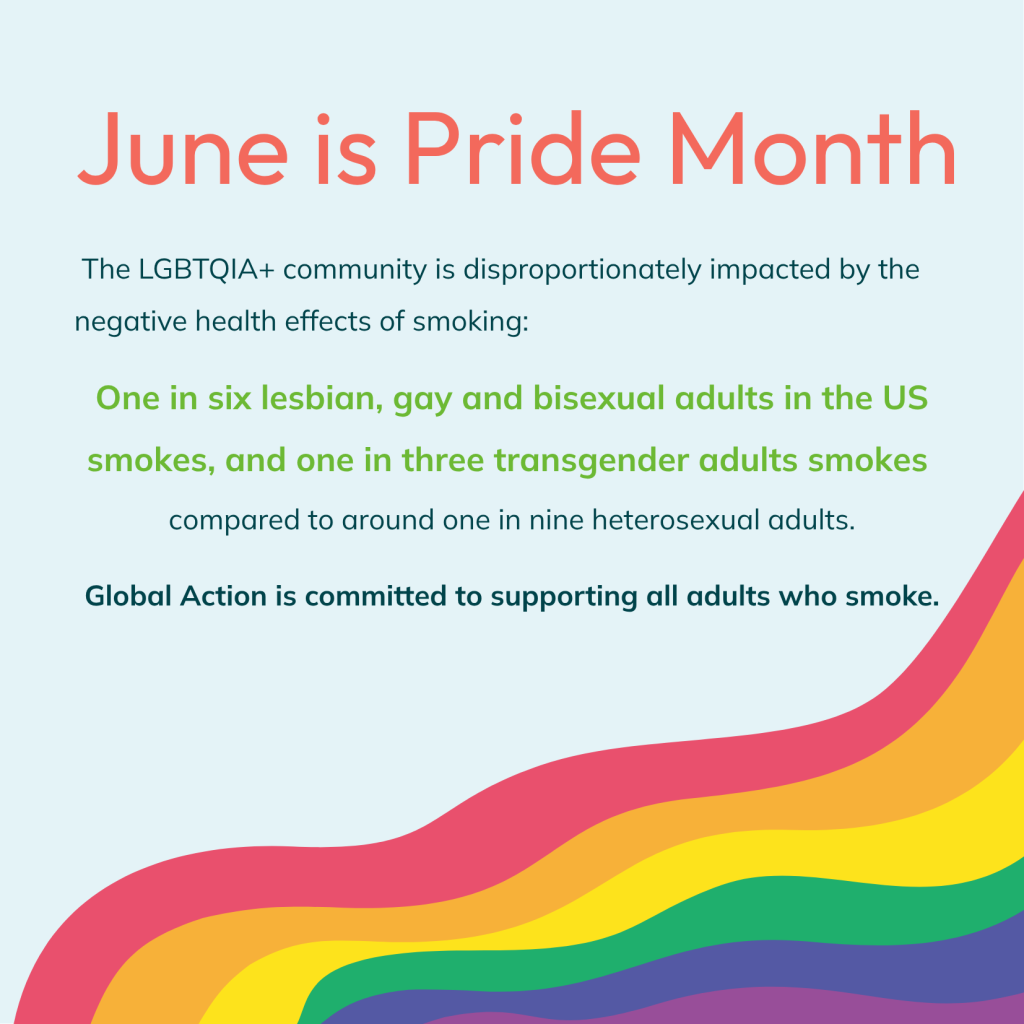
Smoking rates are disproportionately high in certain populations, including those who live with mental health conditions, substance use disorders and/or chronic disease; identify as people of color or indigenous people; live in poverty; live in certain low- or middle-income countries and/or are members of the LGBTQIA+ community.
We support the cessation journeys of all people who smoke, no matter what that journey looks like. The most important aspect of quitting is just that—quitting. Making the choice to stop using nicotine entirely or to use a less harmful form of nicotine is a choice to live a longer, healthier life.
Learn more about all the ways you can quit here.
THANK YOU FOR YOUR SUPPORT
Global Action is one of the only public health groups to embrace tobacco harm reduction as a means of meeting adults who smoke where they are, showing them empathy in their individual cessation journeys, and helping them—if they cannot or will not quit—to reduce their risks of death or disease from combustible cigarettes.
Your support increases the impact our grantees’ work can have on this cause. Together, we can build a future where no one suffers from tobacco-related disease
GET TO KNOW GLOBAL ACTION
Global Action has awarded more than 175 grants to institutions that support the work of over 100 scientists, covering 46 countries on four continents.
Our organization is an independent, U.S. nonprofit 501(c)(3) grantmaking organization whose mission is to end combustible tobacco use, which remains the leading preventable cause of death globally. Through September 2023, Global Action received charitable gifts from PMI Global Services Inc. Global Action does not seek or accept funding from companies that produce tobacco or non-medicinal nicotine products.
To learn more about our work, visit our website.
Disclaimer: This newsletter does not provide medical advice. The information, including but not limited to, text, graphics, images and other material contained in this newsletter are for informational and educational purposes only and does not constitute providing medical advice or professional services. No material in this newsletter is intended to be a substitute for diagnosing or treating a health problem or disease. Those seeking personal medical advice should consult with a licensed physician or other qualified health care provider. Always seek the advice of your licensed physician or other qualified health care provider regarding a medical condition or with any questions you may have regarding treatment and before undertaking a new health care regimen. Never disregard professional medical advice or delay in seeking it because of something you read in this newsletter. No physician-patient relationship is created by this newsletter. Global Action doesn’t make representations, express or implied, with respect to the information provided here.